
Tail Pulse and Pile-up Random Pulse Generator
Tail Pulse and Pile-up Random Pulse Generator
Active Technologies recently added a new feature to implement Tail Pulse and Pile-up Random Pulse Generator into AWG-2000 series. The option allow the user to easy generate random tail pulses in few clicks
Replacing the BNC Model DB-2: Tail Pulse and Pile-Up Generation on the Arb Rider AWG-2184
For decades, laboratories testing nuclear spectroscopy electronics have relied on analog NIM modules such as the BNC Model DB-2 to emulate detector signals. The Arb Rider AWG-2184, equipped with the optional Tail Pulse license, replaces that generation of instruments with a single programmable bench platform and removes the compromises the DB-2 imposed.
Tail Pulse generation without analog limits. On the DB-2, the pulse shape depended on physical RC networks and fixed click-stop selectors. On the AWG-2184, the Tail Pulse is calculated mathematically in real time using 16-bit DDS synthesis. Rise and fall times are set independently and continuously, from 4 ns to 1000 s with 2 ps resolution, while the repetition frequency reaches 25 MHz in Tail Pulse mode. There are no trimmers to adjust, whereas the DB-2 required manual calibration of 13 internal trimmers, including calibration in a thermal oven.
A stable, DC-coupled baseline. The DB-2 used AC coupling at its output, which caused baseline wander of up to 200 mV and ruled out direct connection to DC discriminators or ADCs. In Random mode its amplitude was also cut from 10 V to 1 V. The AWG-2184 is truly DC-coupled and delivers 6 Vpp as standard, or 12 Vpp with the HV option, into 50 Ω. The baseline stays steady at any duty cycle, so the signal you generate is the signal you measure.
Advanced Pile-Up emulation. The DB-2 produced random pulses by exploiting the noise of an avalanche transistor. The AWG-2184 offers a dedicated Pile-Up Mode on Channel 1, with up to four stacked pulses. Pulse arrival times can follow a Uniform or Poisson distribution with an adjustable Distribution Depth. Amplitudes can be constant, random or defined by an arbitrary profile, reproducing a multi-energy radioactive spectrum, and a simultaneous Offset Drift lets you add a baseline disturbance such as a 50 Hz sine wave. Together, these controls make Pile-Up repeatable and fully configurable, which is particularly valuable when validating pile-up rejection and dead-time behaviour before connecting real detectors.
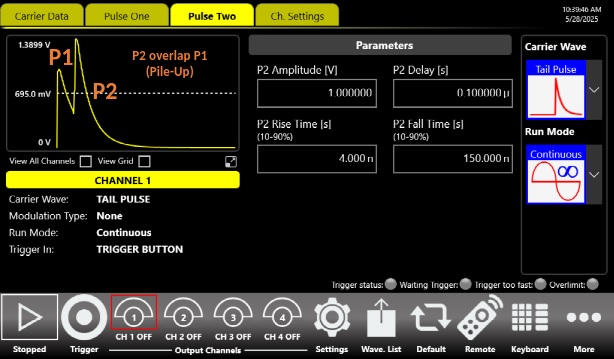
Deterministic Double Tail Pulse. The DB-2 had no Double Pulse function. Testing the resolving time of a Pile-Up Rejector meant connecting an external pulse generator to the EXT TRIG input, and below 120 ns of spacing it stopped working anyway. The AWG-2184 includes a Double Tail Pulse mode with a fully independent second pulse and no overlap constraint: reduce the delay and the second pulse rides on the tail of the first, creating a precise, deterministic Pile-Up without any extra equipment.
Built-in test tools. Differential nonlinearity tests of an MCA no longer require an external ramp generator. The AM-Sweep run mode works as a standalone Sliding Pulser, with Linear, Logarithmic, Upstair or User Defined amplitude laws and a synchronous Marker Out signal. Offset Drift reproduces mains interference or thermal drift to verify Baseline Restorer circuits.
More than a replacement. The AWG-2184 is also a four-channel, synchronized function generator and True-Arb waveform generator, with up to 512 Mpts of memory per channel and an optional 8-bit digital generator. A single instrument therefore replaces the DB-2 and the NIM Bin needed to power it, while the same hardware remains useful for coincidence tests, replaying real detector signals and many other applications. Because parameters are set from the 7-inch touch interface, there are no knobs, switches or capacitor banks to change by hand. For any laboratory still maintaining legacy NIM pulsers, Tail Pulse and Pile-Up generation on the AWG-2184 offers a more accurate, flexible and future-proof alternative.
Ferrara – Italy, 22.10.2026